
2026 Mini Blender vs Full‑Size Blender: Who Really Wins in Real‑Life Use?
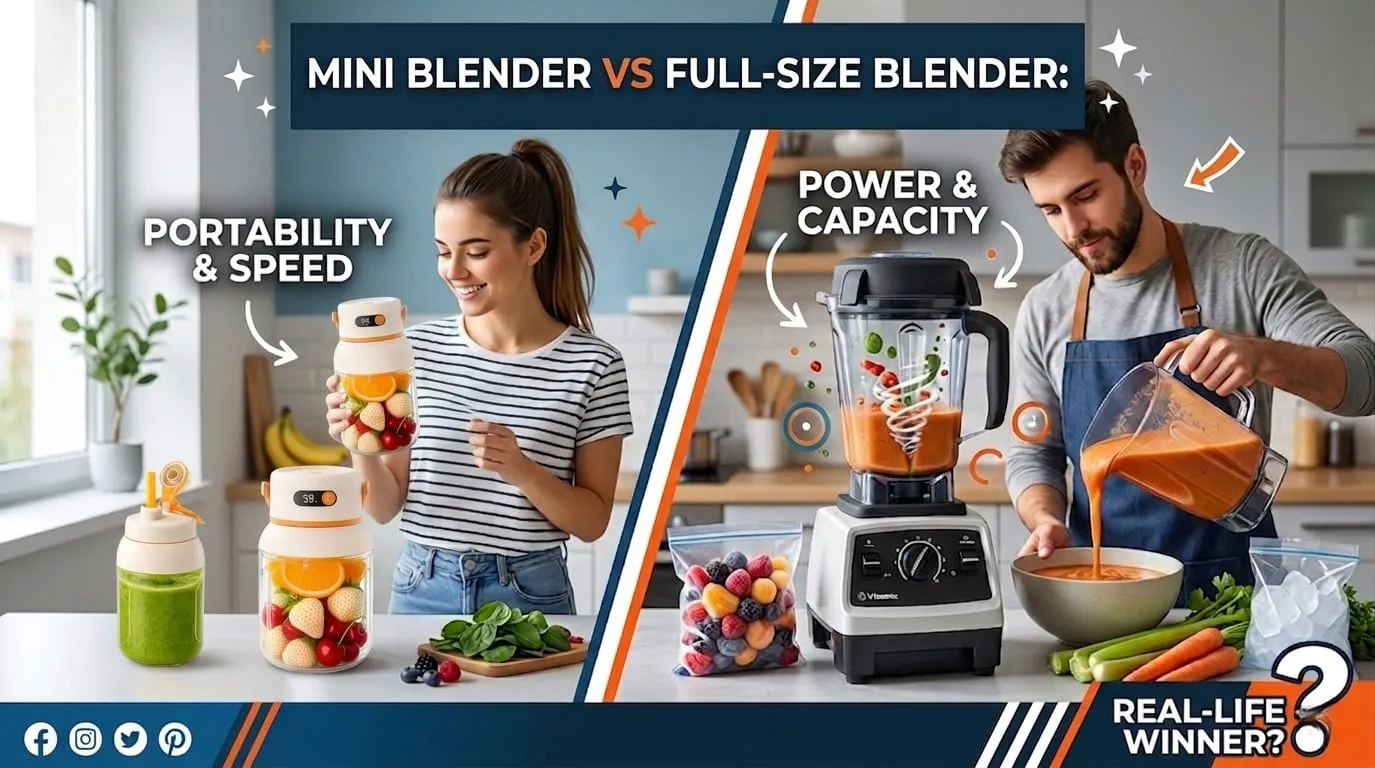
A mini blender helps many users save time in daily food prep. Many people buy a full-size blender and then stop using it because it takes too much space and cleaning time. Some users buy a mini blender and later feel it is not strong enough for some tasks.
This article focuses on performance, not price or style. It helps you decide based on real use cases and real needs. You will learn how to choose based on your daily routine and cooking habits.
Mini Blender vs Full-Size Blender: Basic Definition
People often compare a mini blender with a full-size blender when they choose a kitchen tool. Each type serves a clear use case.
Mini / Personal / Portable Blender
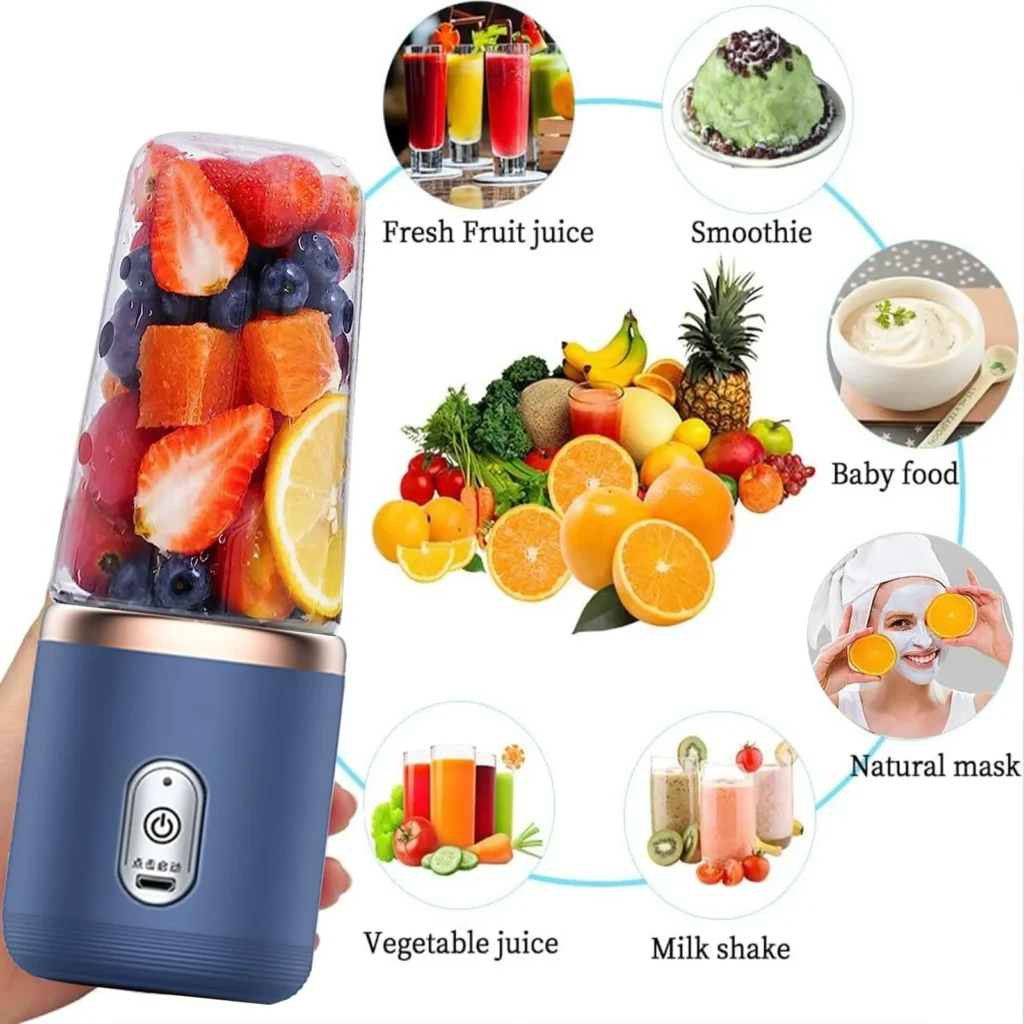
A mini blender works for single-serve food and drinks.
- Capacity: 12–32 oz (single cup use)
- Motor power: about 70–300 W (some high-end models go higher)
- Main use: one-person smoothie, protein shake, light sauce, small milkshake
- Prices range:from $20 to $100.
This type fits users who want fast use and small storage space.
Full-Size Countertop Blender
A full-size blender supports larger portions and heavier food tasks.
- Capacity: 48–72 oz (2–4 servings)
- Motor power: 500–1800 W
- Main use: soup, large smoothie batches, ice crushing, nut butter, baby food
- Prices range:from $100 to $800.
This type fits families or users who cook in larger amounts.
Mini Blender vs Full-Size Blender Comparison
| Dimension | Mini Blender | Full-Size Blender |
|---|---|---|
| Capacity | 12–32 oz | 48–72 oz |
| Motor Power | 70–300 W | 500–1800 W |
| Portability | Easy to carry, gym/work use | Fixed on countertop |
| Cleaning Time | 30–60 seconds | 2–5 minutes (more parts) |
| Price | $20–$100 | $100–$800 |
This comparison shows a simple rule:
A mini blender focuses on single-serve speed. A full-size blender focuses on power and volume.
Mini Blender Performance Comparison (Beyond Basic Specs)
This section explains mini blender performance with real use logic. It goes beyond capacity, power, and price. It adds three layers: physics performance, real test scenes, and user-product match.
Power, Blade, and Real Performance (Mini Blender Focus)
A mini blender does not depend only on motor power. It depends on how motor power and blade design work together.
Power vs Capacity Logic
- A 16 oz mini blender often uses 100–150 W motor
- A 64 oz full-size blender often uses about 800–1000 W motor
Power density matters more in small cups:
- Mini blender moves less volume
- Mini blender creates faster local circulation
- Full-size blender handles more load but needs more total energy
So a mini blender can feel fast in single-serve use.
Blade System Impact in Mini Blender
Blade design directly affects blend quality in a mini blender.
Common blade types:
- Three-blade system: basic mixing, limited ice crush
- Four to five blades: better flow and smoother output
- Multi-layer blade system: stronger contact with ingredients
More blade contact improves:
- Ice crush speed
- Smoothie texture
- Frozen fruit breakdown
BlendCupDaily Blade System Example
BlendCupDaily mini blender uses a stainless steel multi-blade system.
- Base system starts at 6 blades
- Some models use up to 12 blades
- High-end structure reaches up to 34 cutting points
This design increases cutting contact inside a small cup.
Results:
- Better ice crushing in portable blender use
- Smoother fruit blending
- Less shaking needed during operation
- More stable texture in small-volume drinks
This blade structure improves performance in a compact mini blender form factor.
Mini Blender Advantages and Disadvantages
Many people assume before buying a mini blender that it is only a smaller version of a full-size blender and must have weaker performance. But real use often shows a different result. When users make one smoothie, a mini blender often blends faster and gives a finer texture than a full-size blender. Cleaning takes about 30 seconds instead of 3–5 minutes. Users also carry it to the office, gym, and travel trips, while a full-size blender stays at home and is rarely used on busy days.
This leads to another question: if a mini blender has so many advantages, why do some users still feel it is “not enough” and replace it quickly? The next section breaks this down by showing where a mini blender performs better and where it hits clear performance limits.
Mini Blender Advantages in Specific Scenarios
The key logic is simple. A mini blender does not win by being bigger or stronger. It wins in small-portion use, high frequency use, and mobile use. In these cases, it improves efficiency more than a full-size blender.
Small-Batch Smoothie Efficiency Gain
A mini blender performs better when the portion size is 12–16 oz. In a full-size blender, the liquid level stays too low, the blade spins without full coverage of ingredients, and the mix often becomes uneven or chunky. In a mini blender, the cup size matches the serving size, the blade stays in full contact with ingredients, the vortex forms faster in a small space, and the texture becomes smooth in seconds. As a result, a mini blender produces more consistent smoothie texture for single-serve use.
Cleaning Speed Directly Affects Usage Frequency
Cleaning time changes user behavior.
Full-size blender cleaning:
- Remove jar
- Remove blade base
- Wash multiple parts
- Dry and reassemble
- Time: 2–5 minutes
Mini blender cleaning:
- Add water and a drop of soap
- Run blend cycle
- Rinse
- Time: 30–60 seconds
Because cleaning is fast, users tend to use mini blender more often.
Many user reports show that mini blender users often use the device 2–3 times more per day than full-size blender users, based on general consumer feedback data.
You can also estimate your intake using a smoothie calories calculator to better match your fitness goals.
Mobility and “Use Anywhere” Scenarios
Mini blender supports real mobile use:
- Gym: protein shake after workout
- Office: quick breakfast smoothie
- Travel hotel: simple fruit drink
- Camping: small food prep
- Coffee shop stop: fresh mix on the go
Full-size blender stays at home and has no real mobile use case.
Mini blender works because it follows the user, not the kitchen layout.
A mini blender performs better in single-serve, high-frequency, and portable use cases. In these conditions, it does not act as a downgraded full-size blender. It acts as a more efficient tool for specific daily tasks.
Mini Blender Hard Limits: Where Performance Starts to Break
A mini blender works very well in the right situation. But it also has clear limits. These limits appear quickly when the workload becomes larger, harder, or more complex.
Capacity Limit: Small Cup Becomes a Bottleneck
Most mini blender models stop around 32 oz capacity. That size works for one person, but it becomes inefficient for family use or meal prep.
If two or more people need smoothies, users often need to blend 2–3 separate batches. This increases:
- Prep time
- Cleaning cycles
- Battery or power use
For parents, meal prep users, or families making smoothies several days per week, the mini blender can quickly feel slow and inconvenient.
Hard Ingredients: Ice, Frozen Fruit, and Nuts Create a Performance Gap
Mini blender motors usually run between 70–150 W, while full-size blenders often reach 500–1800 W.
This creates a clear difference with solid ingredients.
Ice
Most mini blender models do not include heavy ice-crushing systems. The blade may stall, overheat, or leave ice chunks at the bottom.
Frozen Fruit
100% frozen fruit without milk or water often blocks blade movement. Users usually need extra liquid to restart blending.
Nuts
Mini blender models can handle thin nut mixtures, but they struggle with real nut butter. Ingredients collect under the blade and reduce smooth flow.
No Hot Soup Function: Cold Blend Only
A mini blender supports cold blending only.
It works well for:
- Smoothies
- Protein shakes
- Cold sauces
- Cold soups
But it cannot replace a hot soup blender.
Many full-size blenders use strong blade friction to heat ingredients during long blending cycles. Some models can raise soup temperature above 80°C within 10–15 minutes.
A mini blender does not produce that level of heat or sustained power.
Family Upgrade Problem: Mini Blender Stops Scaling
A mini blender fits single-person life very well. But family life changes kitchen needs.
Once users have:
- Children
- Shared kitchens
- Weekend gatherings
- Multiple smoothie drinkers
the small cup becomes a limit very quickly.
At that stage, the mini blender usually changes from “main blender” to “secondary blender.”
A mini blender is not a weaker version of a full-size blender. It is a specialized tool with clear limits.
In single-serve, portable, and high-frequency use, it can deliver better speed and better daily experience. But once users need family-size portions, heavy ice crushing, frozen fruit blending, nut butter, or hot soup, the performance advantage disappears and becomes a limitation.
Full-Size Blender Real Performance Leverage: Advantages and Performance Traps
A full-size blender shows its real value when the workload becomes larger, harder, or more demanding. This is where motor size, blade torque, and large capacity create a clear performance gap over a mini blender. But many users also fall into a different problem: buying more power than they actually use.
Full-Size Blender Scenarios With Clear Performance Advantage
A full-size blender performs best in high-volume and high-resistance blending tasks.
Multi-Person Smoothies and Meal Prep
A full-size blender can make smoothies for 2–4 people in one cycle. This matters for:
- Families
- Couples
- Weekly meal prep
- Shared kitchens
Users can prepare multiple servings at once instead of repeating small batches.
Ice, Frozen Fruit, Nut Butter, and Baby Food
This is where full-size blender power becomes obvious.
Strong motors and larger blade systems handle:
- Ice crushing
- Frozen fruit blending
- Thick nut butter
- Dense baby food mixtures
The blade keeps stable rotation under heavy load. The texture also becomes smoother and more consistent.
Soup, Hot Drinks, and Shake Bases
Many high-end full-size blenders support heat buildup through blade friction.
Users can make:
- Hot soup
- Warm sauce
- Thick milkshake base
- Heated vegetable blends
This creates a cooking function, not just a blending function.
Large Batch Fitness or Low-Fat Meal Prep
Many fitness users prepare 3–5 days of smoothies or low-fat meals at one time.
A full-size blender helps because it:
- Reduces repeat prep work
- Handles large ingredient volume
- Keeps texture consistent across servings
For high-frequency batch prep, a mini blender becomes inefficient very quickly.
Full-Size Blender Performance Traps
A full-size blender can also create waste when users buy more machine than they actually need.
Overbuying Power
Some users buy a 1800 W blender for a one-person kitchen but only use it for one smoothie per day.
This creates several problems:
- Large cup waste
- Extra cleaning time
- Higher electricity use
- More countertop space occupied
In daily use, much of the machine’s power stays unused.
Power Numbers Alone Do Not Guarantee Better Performance
Many brands promote high wattage numbers. But motor power alone does not guarantee smooth blending.
Blade design also matters:
- Blade angle
- Blade layering
- Cup flow structure
- Ingredient circulation path
Some 1800 W blenders still struggle with nuts or frozen ingredients because the blade system creates poor ingredient flow.
Professional review platforms like RTINGS and Consumer Reports often show that blending performance depends on the full system, not wattage alone.
A full-size blender performs best in large batches, hard ingredients, hot blending, and family use. But buying maximum power without matching real use needs often creates wasted space, wasted money, and lower daily usage.
How to Choose the Right Blender: From User Profiles to Product Matrix
Many users get stuck between two choices.
Should you buy a mini blender because it feels faster and easier for daily use?
Or should you buy a full-size blender because it looks more powerful and future-proof?
The real question is not “Which blender is more expensive?” The real question is: which blender matches your daily routine, kitchen space, and food habits?
Some people need portability and quick cleaning. Others need batch prep, frozen fruit blending, or family-size smoothies. Some users actually need both.
This section uses real user profiles to show which blender type fits different lifestyles and why.
User Profiles × Blender Choice
Gym Office Worker (One Smoothie Every Morning)
Best Fit: Mini Blender
Optional Upgrade: Full-size blender later for family use
A gym office worker usually makes one smoothie before work or after training.
Why a mini blender works better:
- Small single-serving volume
- Fast blending time
- Portable cup for commuting
- Quick cleaning before leaving home
A full-size blender may feel oversized for one daily protein shake. For more ideas, explore greek yogurt smoothie recipes to upgrade your daily protein drinks.
Young Single Adult (Small Apartment Kitchen)
Best Fit: Mini Blender
A young renter often has:
- Limited kitchen space
- Small sink area
- Minimal countertop storage
Why mini blender fits:
- Compact storage
- USB charging options available
- 30–60 second cleaning
- Enough power for daily smoothie or protein shake
For one-person use, a full-size blender often creates unnecessary cleaning and storage pressure.
Parent With Baby (Baby Food + Personal Smoothies)
Best Fit: Mini Blender + Full-Size Blender Combination
This profile often needs two different workflows.
Why:
- Baby food needs smoother texture and larger volume
- Full-size blender handles vegetables and dense food better
- Parent may still want a quick personal smoothie during busy mornings
In this setup:
- Full-size blender becomes the family prep machine
- Mini blender becomes the personal daily-use machine
The combination improves flexibility instead of forcing one blender to do everything.
Family Kitchen User (3–4 People, Parties, Weekend Drinks)
Best Fit: Full-Size Blender
Secondary Tool: Mini Blender for portable use
Family kitchens usually need:
- Larger smoothie batches
- Ice drinks for multiple people
- Party or weekend drink prep
Why full-size blender works better:
- 48–72 oz capacity
- Stronger ice crushing
- Faster multi-cup production
A mini blender still helps for:
- Personal shakes
- Small quick drinks
- Portable use outside the kitchen
But it should not be the main blender in a multi-person home.
Outdoor or Camping User
Best Fit: Mini Blender
Outdoor users need:
- Portability
- Rechargeable battery
- Lightweight setup
- Easy transport
A full-size blender has almost no outdoor advantage because it depends on fixed kitchen space and wall power.
Mini blender works well for:
- Travel smoothies
- Protein shakes
- Simple fruit drinks during trips
Portable mini blender design becomes much more useful in this lifestyle.
When to Buy a Mini Blender vs When to Buy a Full-Size Blender
Many users do not struggle with blender performance. They struggle with fit.
Some people buy a full-size blender for a simple daily smoothie and stop using it because it is too large and takes too long to clean. Some people buy a mini blender, then later find it cannot handle family meals, frozen fruit, or batch prep.
The real decision depends on your usage pattern, not power or price. You need to look at serving size, frequency, and whether you cook for one person or a group.
When You Should Buy a Mini Blender First
If your situation matches 2–3 points below, a mini blender is usually the better first choice:
- You live alone or with one other person
- Your kitchen has limited counter space
- You make 1–2 smoothies or protein shakes per day
- You need portability for gym, office, travel, camping, or car use
For example, many users make one protein smoothie before leaving home or one fruit shake after the gym. In this routine, a mini blender performs better because it is fast, easy to clean, and easy to carry. A full-size blender often adds unnecessary steps without improving daily experience.
When You Should Buy a Full-Size Blender First
If your daily use looks like the cases below, a full-size blender should be your main machine:
- You prepare smoothies or frozen drinks for 3–4 people
- You often blend frozen fruit, ice, nut butter, or baby food
- You make hot soup, large milkshakes, or party drinks
- You prepare 3–5 days of fitness meals or meal prep at one time
For example, making frozen fruit smoothies for a whole family or preparing nut butter for breakfast requires higher power and larger capacity. A full-size blender handles heavy loads more consistently. A mini blender can still help, but it becomes a secondary tool in this situation.
When the Best Choice Is a Mini + Full-Size Combination
Some users benefit most from using both types of blenders.
You should consider a combination setup if you have:
- A daily single-serve smoothie routine
- A weekly family cooking or batch prep routine
For example:
- Morning: use a mini blender for a quick protein smoothie before work because it is fast, portable, and easy to clean
- Weekend: use a full-size blender to make frozen drinks, nut butter, soup, or large smoothies for the family
This setup works well because each blender serves a different role. The mini blender supports high-frequency personal use. The full-size blender supports large-volume and heavy-duty blending.
It also avoids two common problems:
- Buying a large blender that stays unused most of the time
- Buying a small blender that becomes too limited when needs grow
BlendCupDaily Mini Blender: Where the Design Actually Improves Real Use Experience
Many mini blenders are just smaller versions of full-size countertop machines. They often show the same problems in a smaller body: weak motor, loud noise, leaking cups, difficult cleaning, and poor performance with ice, frozen fruit, or nuts.
BlendCupDaily Mini Blender is not built as a smaller replica. It is designed for small-volume use, high-frequency daily routines, and mobile scenarios.
Below are four key design improvements that show where it performs differently, and why it fits single-serve daily use, portability, and fast cleaning workflows.
1. 70W+ Small-Capacity Motor for Ice and Frozen Fruit Stability
Many mini blenders use low-power motors that struggle with ice, frozen fruit, and nuts. Users often face blade stalling, overheating, or uneven texture at the bottom of the cup. In some cases, they need to add extra liquid just to keep the blend moving, which changes the original taste.
A well-designed mini blender uses a 70W+ motor optimized for 12–32 oz cups. This improves torque stability in small volumes and keeps the blending process smooth and consistent. In real use, frozen fruit smoothies and nut-based drinks can be finished in seconds without dilution. A user can prepare a thick morning smoothie with natural texture instead of watering it down to help the blade move.
2. Multi-Layer Blade + Low Center-of-Gravity Cup for Smoother Texture
Traditional mini blenders often use simple three-blade systems with flat cup bases. This design creates weak circulation inside the cup. Ingredients like spinach, protein powder, or nuts often collect at the bottom, which leads to uneven blending and visible residue.
A better design uses multi-layer blades combined with a low center-of-gravity cup base. This structure helps create a stable vortex inside a small space, increasing ingredient contact during blending. In daily use, this means green smoothies come out smoother, protein shakes mix more evenly, and nut-based drinks feel finer without gritty texture. For users focused on fitness or clean eating, this difference is easy to notice.
3. One-Piece Sealed Cup for Carry-and-Drink Convenience
Many mini blenders fail not in blending performance, but in daily workflow. Some cups leak, lids do not seal tightly, and users must transfer drinks into another bottle. This adds extra cleaning steps and reduces how often the product is actually used.
A one-piece sealed cup solves this by combining blending and drinking in the same container. Users can blend a drink, close the lid, and take it directly to work, the gym, or travel. Cleaning is also simplified to a quick rinse or a 30–60 second wash. In real life, a morning smoothie becomes a one-step routine: blend, close, go. This reduces friction and increases daily usage frequency.
4. Low-Noise Design for Offices, Small Kitchens, and Shared Spaces
Noise is a hidden reason many mini blenders are not used regularly. Even small motors can create high-pitch sound that feels disruptive in shared spaces like offices, dorm rooms, or small apartments. This makes users avoid using them in the morning or at night.
A well-designed mini blender reduces vibration and motor noise through internal balance and structural damping. In real usage, noise stays within a controlled range that is suitable for shared environments. Users can make a smoothie in an office pantry or small kitchen without worrying about disturbing others. This makes the product more practical for real daily routines instead of being limited by environment.
BlendCupDaily’s Mini Blender focuses on one idea: reduce friction in daily use. With a small-volume optimized motor, multi-layer blade system, sealed carry cup, and low-noise structure, it turns a mini blender into a high-frequency daily tool instead of an occasional kitchen appliance.
Conclusion
A mini blender is best when you make one drink at a time. It works faster, cleans faster, and fits daily routines like gym, office, and travel. It handles smoothies, protein shakes, and small frozen fruit portions well, and it is built for speed and convenience in single-serve use. A full-size blender is better when you cook for 2–4 people or more. It handles large batches, ice, frozen fruit, nuts, and even hot soup with more power and capacity, which makes it suitable for family meals and meal prep.
The simple rule is clear: if you blend for yourself every day, choose a mini blender; if you cook in large amounts for others, choose a full-size blender; if you do both, use both tools for different tasks.
If your life is built around fast mornings, gym shakes, office drinks, and easy cleaning, BlendCupDaily Mini Blender is made for this exact routine. It helps you blend one smooth drink in seconds, carry it in the same cup, and clean it in under a minute, so your day keeps moving without interruption.
👉 Get BlendCupDaily Mini Blender and turn your daily smoothie into a simple 30-second habit.