
Smoothie Calories Calculator: Unlock Your Drink’s Full Nutritional Value
Many people search smoothie calories because they want a healthy drink option, but the number can be misleading. A smoothie is not always low in calories. It can match a full meal depending on ingredients.
A homemade smoothie can range from 150 to 800+ calories per cup. The final number depends on what you put inside the cup, such as fruit, milk, yogurt, nut butter, or sweeteners.
I still remember one morning when I made a “healthy” smoothie with banana,eanut butter, whole milk, and honey. It tasted good, but later I realized it had more calories than my lunch. That experience changed how I think about smoothies.
In this article, you will learn:
- How many calories are in one smoothie
- How to calculate smoothie calories in a simple way
- How to adjust ingredients for better control
- How BlendCupDaily builds calorie-friendly smoothie ideas
The goal is simple. You will know what is inside your smoothie and how to control it while keeping good taste.
Quick Start: Check Your smoothie calories first
Before you continue reading, use the “Smoothie Calorie Calculator” below to check your smoothie calories.
Enter your ingredients and amounts. The tool will show an estimated calorie range. It will also label your drink as breakfast, meal replacement, or high-energy smoothie.
You can then use this result with the ingredient calorie list in the next section. This helps you control smoothie calories with more accuracy and avoid guessing.
Smoothie Calorie Calculator
Start creating your own healthy smoothie with the BlendCupDaily portable blender. Customize your ingredients, control your calories, and build a drink that perfectly fits your fitness and wellness goals.
Ingredient Calorie Library for smoothie calories
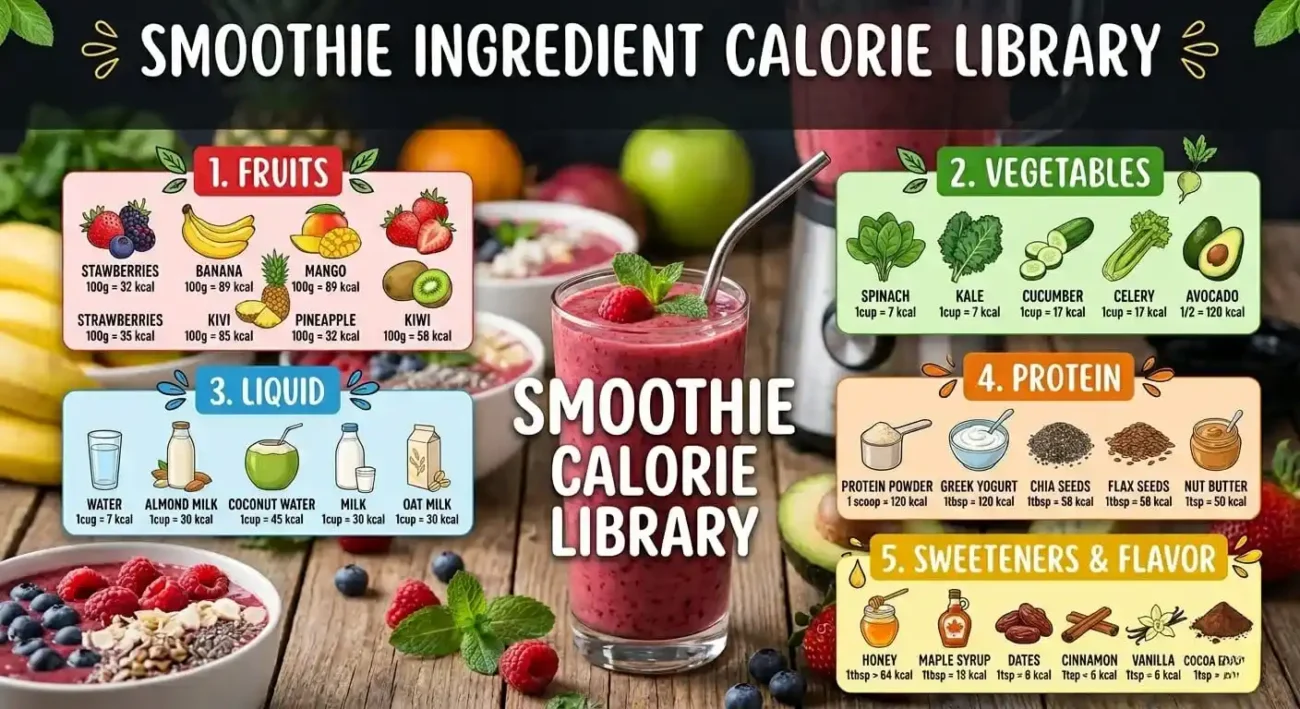
This section helps you calculate smoothie calories in a simple way. Each ingredient shows a clear calorie reference so you can build your own drink step by step.
🍓 1. Fruits for smoothie calories (Main flavor + sugar source)
Fruits are the base of most smoothies. They add taste and natural sugar.
| Fruit | Calories (per 100g, approx.) | Best use |
|---|---|---|
| Mango 🥭 | 60–70 kcal | High sugar, strong flavor, use small amount |
| Pineapple 🍍 | 50–55 kcal | Tropical taste, use small amount |
| Apple 🍎 | 50–55 kcal | Sweet, high fiber, good for fat loss smoothies |
| Pear 🍐 | 55–60 kcal | Light sweetness, high water |
| Peach 🍑 | 40–45 kcal | Low calorie, good for larger amount |
| Cherry 🍒 | 50–55 kcal | Small size, use limited amount |
| Raspberry | 50–55 kcal | Low sugar, high fiber |
| Blackberry | 50–55 kcal | Low sugar, high antioxidants |
| Dragon Fruit | 50–55 kcal | Low taste, good for color |
| Kiwi 🥝 | 55–60 kcal | Fresh taste, moderate calories |
| Orange 🍊 | 45–50 kcal | Citrus flavor, use small amount |
| Orange Juice 🍊 (100ml) | 40–50 kcal | High sugar, better to replace with whole fruit |
| Watermelon 🍉 | 30–35 kcal | High water, very low calories |
🍓 Fruit tips
- High sugar fruits (mango, pineapple, orange juice): use 1–2 portions only
- Low sugar fruits (berries, dragon fruit, watermelon): can use more without large calorie increase
- For easier calculation of smoothie calories, fruit calorie ranges (such as 50–55 kcal) use 52–53 kcal as the average reference value
🥬 2. Vegetables for smoothie calories (Green smoothie base)
Vegetables help reduce calories and add fiber.
| Vegetable | Calories (per 100g, approx.) | Best use |
|---|---|---|
| Spinach | 23 kcal | Low calorie, high fiber |
| Kale | 49 kcal | Slight bitter taste, use small amount |
| Cucumber 🥒 | 15–20 kcal | High water, good for dilution |
| Celery | 16 kcal | Very low calorie |
| Carrot 🥕 | 41 kcal | Natural sweetness |
| Beetroot | 43 kcal | Color + sweetness |
| Zucchini | 17 kcal | Neutral taste |
| Lettuce | 15–20 kcal | Light texture |
🥬 Vegetable tips
- Spinach and kale: use 1–2 cups without large calorie increase
- Carrot and beetroot: use small amount to add sweetness
- For easier calculation of smoothie calories, vegetable calorie ranges (such as 15–20 kcal or 40–45 kcal) use the mid-range value as the reference
🥛 3. Liquid bases for smoothie calories
Liquid affects total smoothie calories more than people expect.
| Liquid | Calories (per 100ml, approx.) | Best use |
|---|---|---|
| Water 💧 | 0 kcal | Zero calorie base |
| Coconut Water 🥥 | 45–60 kcal | Post-workout drink |
| Oat Milk | 45–55 kcal | Popular plant milk |
| Soy Milk | 45–55 kcal | High protein plant milk |
| Coconut Milk | 230–250 kcal | High fat, use small amount |
| Cashew Milk | 25–35 kcal | Low calorie option |
| Cold Brew ☕ | 0–5 kcal | Coffee smoothie base |
| Green Tea 🍵 | 0–2 kcal | Antioxidant base |
🥛 Liquid tips
- Coconut milk: use 30–50ml only due to high calories
- Plant-based milk (oat milk, soy milk): good balance for low-calorie smoothies
- For easier calculation of smoothie calories, liquid calorie ranges (such as 45–55 kcal / 100ml) use 50 kcal as the average reference value
💪 4. Protein ingredients for smoothie calories (Muscle support)
These ingredients increase protein and calories.
| Ingredient | Calories | Best use |
|---|---|---|
| Whey Protein | 380 kcal / 100g | Gym smoothies |
| Plant Protein | 350–380 kcal / 100g | Vegan option |
| Collagen Powder | 380 kcal / 100g | Skin and joints |
| Peanut Butter 🥜 | 580 kcal / 100g | High calorie boost |
| Almond Butter | 600–620 kcal / 100g | High fat energy |
| Greek Yogurt | 60–70 kcal / 100g | Fat loss smoothies |
| Silken Tofu | 70–80 kcal / 100g | Light protein base |
💪 Protein tips
- 1 scoop protein powder ≈ 30g ≈ 110–120 kcal
- Nut butter (peanut or almond): 1 tbsp ≈ 16g ≈ 90–100 kcal
- For easier calculation of smoothie calories, protein powder calorie ranges (such as 350–380 kcal / 100g) use 365 kcal as the average reference value
🍯 5. Sweeteners & flavor for smoothie calories
| Ingredient | Calories | Best use |
|---|---|---|
| Maple Syrup 🍁 | 260–270 kcal / 100g | Natural sweetener |
| Dates | 280–300 kcal / 100g | Whole food sugar |
| Agave Syrup | 290–310 kcal / 100g | High sugar |
| Cocoa Powder 🍫 | 270–290 kcal / 100g | Chocolate flavor |
| Vanilla Extract | 0–5 kcal | Flavor only |
| Cinnamon | 247 kcal / 100g | Small use |
| Matcha Powder 🍵 | 290–310 kcal / 100g | Energy boost |
🍯 Sweetener tips
- Dates: use 1–2 pieces only due to high sugar
- Syrups (maple or agave): keep to 1 tbsp max
- Spices (cinnamon, vanilla): can use freely with very low calories
For more detailed and official nutrition data, you can check:
USDA FoodData Central – FDC
This is the U.S. Department of Agriculture’s official food nutrition database, where you can view exact calorie and nutrition values for thousands of foods.
Smoothie calories for different goals (meal types and calorie targets)
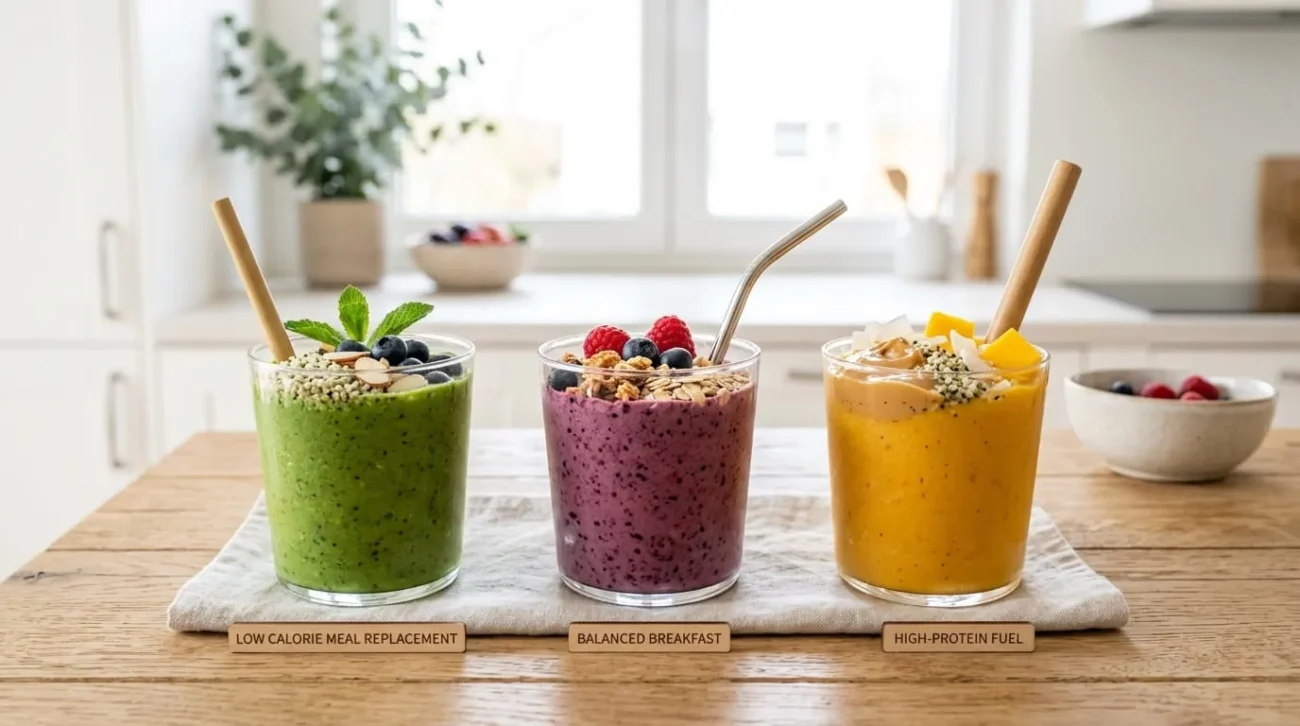
People use smoothies in different ways. Each goal needs a different smoothie calories range. You can use the templates below to build your own drink.
Breakfast smoothie calories (300–500 kcal)
This type gives steady energy for the morning. It should balance carbs, fiber, and light protein.
| Goal | Calorie range | Build direction |
|---|---|---|
| Breakfast smoothie | 300–500 kcal | Fruit + oats + milk + light protein |
Simple structure:
- 1–2 fruits (banana, apple, berries)
- 200–300ml milk or plant milk
- 20–40g oats or chia seeds
- Optional: yogurt or protein powder
This type works as a normal breakfast replacement when calories are balanced.
Meal replacement smoothie calories / Low-cal smoothie (200–400 kcal)
This type supports fat control. It keeps calories lower but still fills the stomach.
| Goal | Calorie range | Build direction |
|---|---|---|
| Meal replacement smoothie | 200–400 kcal | Low sugar fruit + greens + water base |
Simple structure:
- 1 low-sugar fruit (berries, watermelon, kiwi)
- Spinach or cucumber for volume
- Water or low-cal plant milk
- Optional: 1 scoop protein powder
This is also a low-cal smoothie option for weight control.
High-protein smoothie calories (400–700 kcal)
This type supports muscle gain and workout recovery. It has higher energy and protein.
| Goal | Calorie range | Build direction |
|---|---|---|
| High-protein smoothie | 400–700 kcal | Fruit + protein + nut butter + milk |
Simple structure:
- 1–2 fruits (banana, mango)
- Milk or oat milk base
- 1 scoop protein powder
- 1 tbsp peanut butter or almond butter
- Optional: oats or chia seeds
This type works best after training or heavy activity.
Conclusion
Smoothies may look like a healthy, low-calorie choice, but their actual calorie content can vary widely—from around 150 to over 800 calories depending on ingredients. The key to keeping them aligned with your health goals is understanding what goes into your blend, from fruits and liquids to protein and sweeteners, and adjusting portions accordingly. By learning how to break down and control each component, you can enjoy smoothies that are both delicious and tailored to your needs, whether for breakfast, meal replacement, or post-workout recovery.
If you want to truly control the calories in every smoothie instead of guessing, use the BlendCupDaily blender to define your own ingredients, ratios, and health goals. Whether you’re focusing on fat loss, muscle gain, or everyday wellness, you can easily create a personalized healthy smoothie that fits your needs. Start now with BlendCupDaily portable blender and enjoy a smoothie that is fully under your control.